No title? No problem in most cases. Free towing, cash on the spot.
Published October 19, 2026 by Instant Money Junk Cars
What happens to junk cars that nobody buys? The short answer is that the premise rarely holds: any car offered for sale at a realistic price finds a buyer, because the market for old cars is efficient down to the last usable part. But the longer answer, the actual end-of-life path from driveway to crusher to new steel, is worth understanding, especially if you are deciding what to do with a car you assume no one wants.
Cars are among the most recycled consumer products in existence, and the system that processes them is a genuine industry, not a junkyard stereotype. This guide follows a junk car's afterlife: the parts harvest, the fluid handling, the shredder, and the environmental math, plus the reassuring close that your car, whatever its state, has a buyer waiting.
Abandoned ones can, but any car actively offered for sale at a realistic price finds a buyer. The old-car market clears at every level: runners go to drivers, rough runners go to mechanics, non-runners go to parts buyers, and parts cars go to shredders. A car only sits unsold when the asking price exceeds what the market will pay for its condition, which is a pricing problem, not a demand problem.
If you have been told your car is worthless, get a second data point before believing it. An online quote prices the car on its actual condition, and what junk cars actually sold for in South Florida shows real transaction ranges rather than guesses. The cars that "nobody wants" are, without exception, cars priced above their condition.
Usable parts are removed and resold, fluids are drained and recycled, and the shell is shredded with metals separated for smelting. The sequence matters: engines, transmissions, body panels, interiors, and electronics with remaining life are harvested first, because a used part is worth far more than its weight in scrap. What cannot be reused, tires, glass, shredder fluff, goes to its own processing streams.
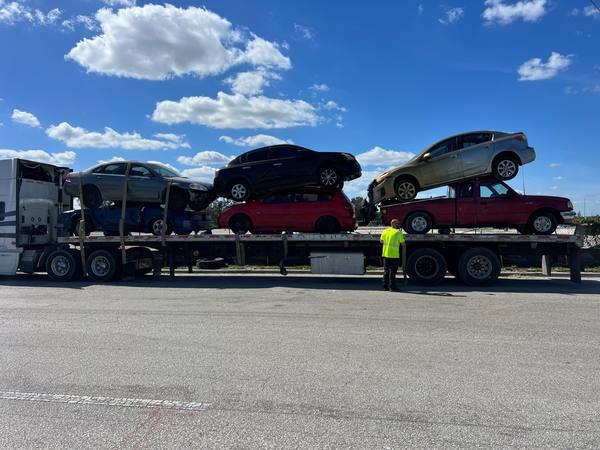
Then the hulk goes to the shredder: a massive hammermill that reduces the shell to fist-sized fragments in under a minute. Magnets pull the ferrous metals, eddy currents separate the aluminum and copper, and the sorted metals go to smelters to become new steel and new aluminum. Our auto recycling in South Florida covers the local side of this industry, and what happens to your car after we buy it follows our vehicles through the same chain.
Roughly three-quarters by weight, mostly steel. That figure makes cars one of the most recycled products on earth, ahead of most household materials by a wide margin. The steel in a shredded car typically returns as new steel within months: construction beams, appliances, and, fittingly, new cars. Aluminum wheels, copper wiring, and platinum-group metals from catalytic converters are recovered at high rates because they are valuable enough to justify the separation.
The remaining quarter is the industry's ongoing challenge: glass, rubber, plastics, and mixed materials that are harder to separate economically. Recycling technology keeps improving the recovery rate, but the honest picture is that most of a car becomes new metal and a minority becomes waste. Compared against the alternative, a car decaying in a yard and leaching fluids into the soil, the recycling path is the environmental win by a distance. What happens when you junk a car in Florida covers the state-specific version of this process.
Licensed recyclers drain oil, coolant, transmission fluid, and fuel for proper processing: waste oil is re-refined or burned as industrial fuel, coolant is recycled, and gasoline is handled as hazardous material. Batteries go to dedicated lead-acid recycling streams, where the lead, plastic, and acid are each recovered; lead-acid batteries are in fact one of the most recycled products in the world. Refrigerant from the AC system is captured rather than vented, as the law requires.
This is the part of the process that separates licensed recyclers from backyard operations. Unlicensed dismantling dumps fluids into the ground, which is both illegal and the reason legitimate buyers document their downstream chain. When you sell to an established buyer, the environmental handling is part of what you are paying for with the transaction. How pickup works is the first step of that chain.
Abandonment risks fines, and the car still gets crushed eventually: the county tows it, the fees accumulate, and the vehicle enters the same recycling stream, except you paid for the privilege instead of being paid. Selling puts cash in your pocket for the same outcome, with the fluids handled properly and the paperwork closed cleanly. There is no scenario where abandonment outperforms a sale.
There is also the timeline to consider. An abandoned car does not disappear; it sits for weeks or months while the county processes it, accumulating storage fees that can follow the registered owner. During that time it leaks fluids, attracts dumping, and draws complaints, all of which attach to you as the last titled owner. A same-day as-is sale ends all of that in one visit: the car leaves on a truck, the title transfers, and your liability ends with the signed bill of sale.
If the reason you have not sold is the assumption that no buyer exists for your car's condition, that assumption is almost certainly wrong. Parts demand, scrap value, and the efficiency of the market mean the floor for a complete car is real money. Equipment values move with commodity markets, and our article on how scrap prices affect your offer explains the mechanics. Call 954-787-5717 with the year, make, model, and condition, and you will have a firm number for a car you thought nobody wanted.
FAQ
Call 954-787-5717 for a cash offer. Free towing, cash on the spot, pickup usually within about an hour.
954-787-5717
 954-787-5717